Route Editor
 Route Scout

| Guide | ♦ | 77 Triplogs | 7 Topics |
details | drive | no permit | forecast | 🔥 route |
stats |
photos | triplogs | topics | location |
| 870 | 77 | 7 |
Canyons are inherently risky. Flash floods occur without notice on sunny days. Technical skills & surrounding topography knowledge required yet does not eliminate risk.
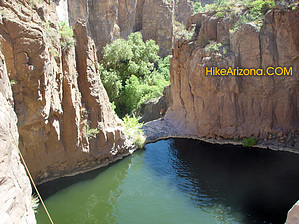
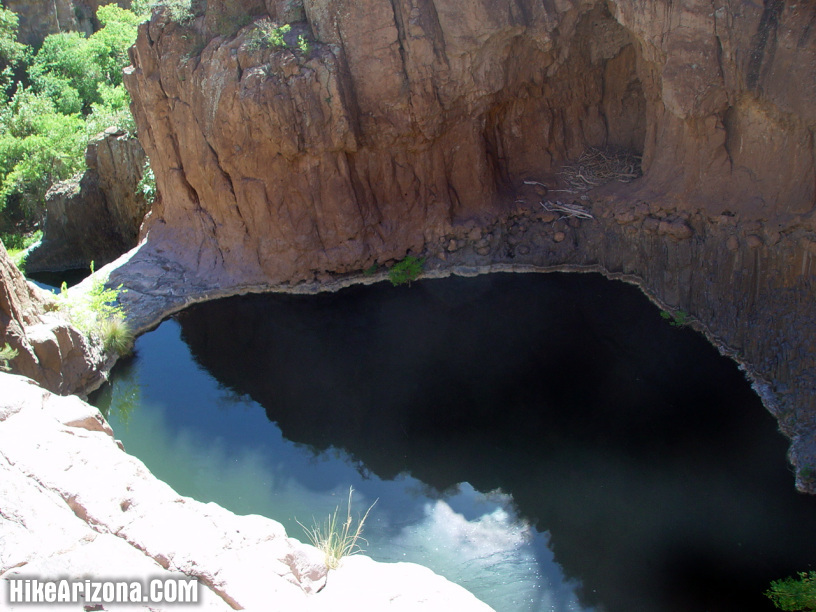
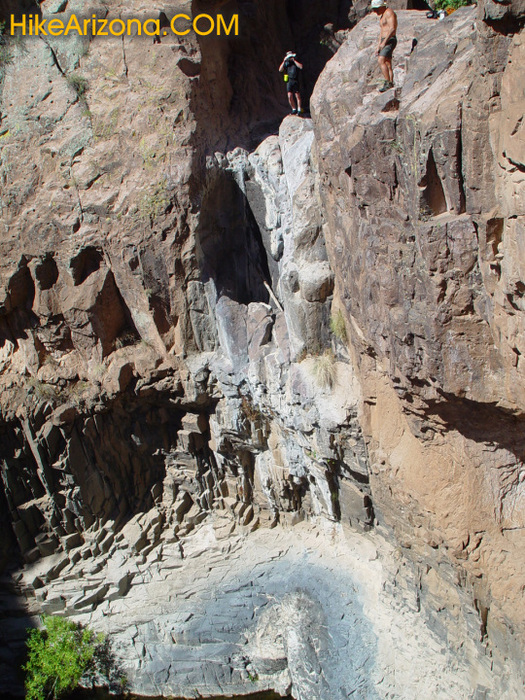
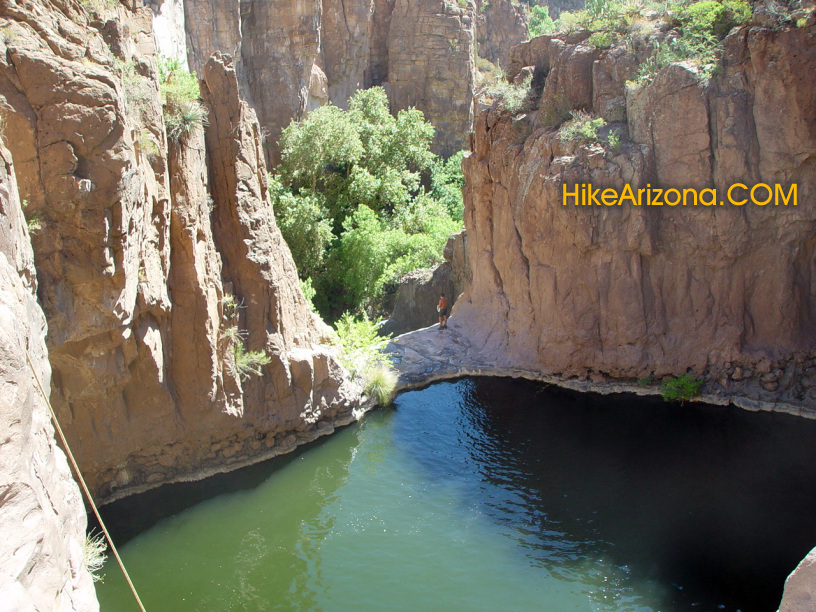
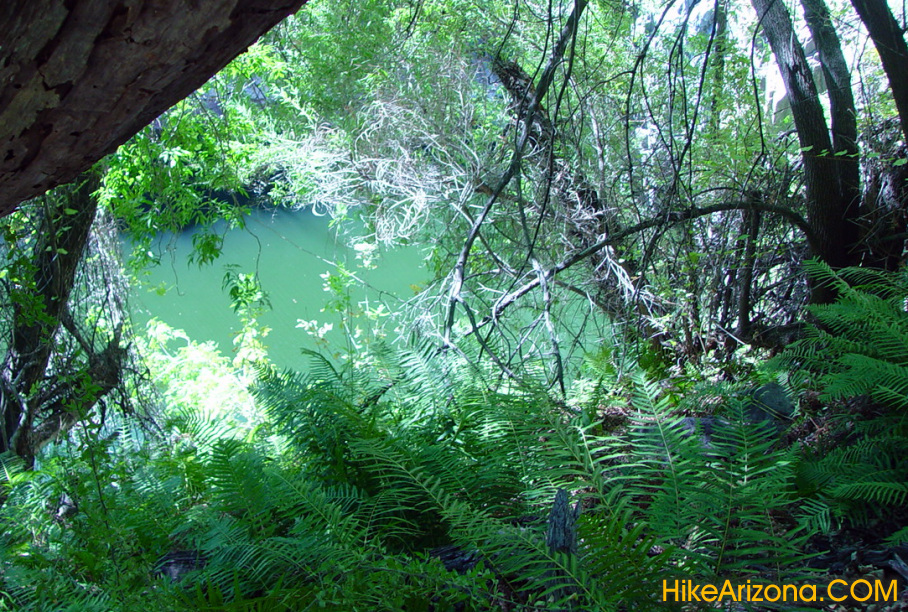
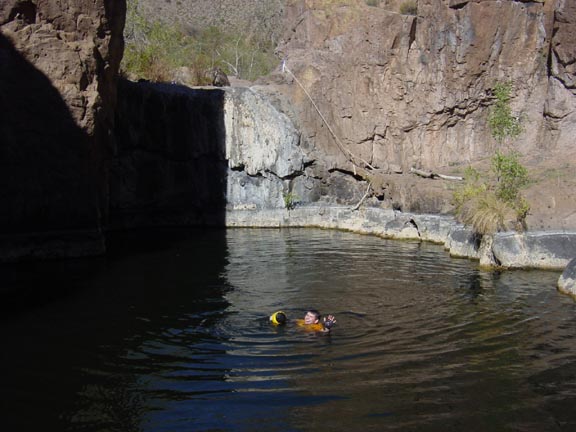
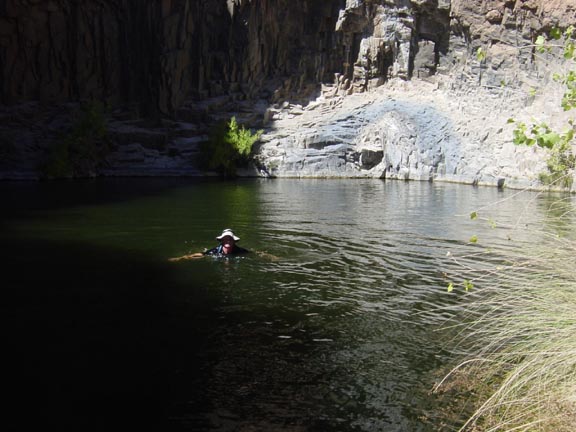
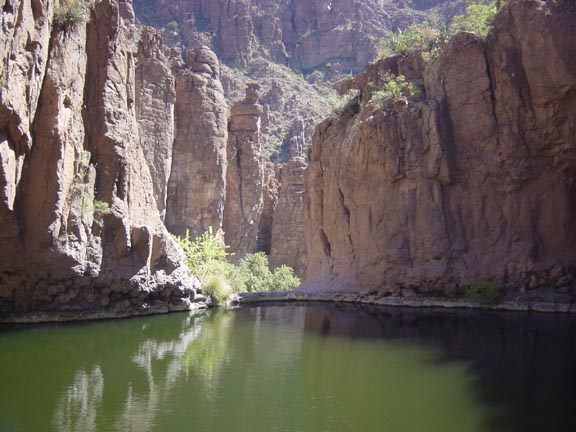
 Overview OverviewHere's an out-n-back trek to the "Five Pools." Which is a downward swerve of layered swimming holes. Be forewarned as this is rather strenuous, not elevation or distance-wise: just constant scrambling in addition to bushwhacking, rappelling & climbing. No actual trail exists, just real beauty worth the effort. Tack on the 4x4 approach for one complete adventure. Best hike this trip April through June and September into October when rain isn't forecasted. Winter would be acceptable to the pools, but the monsoon season is risky and just too hot. You might squeak out March & November with a wetsuit. Desert Emeralds I tagged along with Fritzski and his buddy Bruce on this incredible trip. A quarter-mile east from the windmill in Hackberry Canyon, head east/down the canyon.
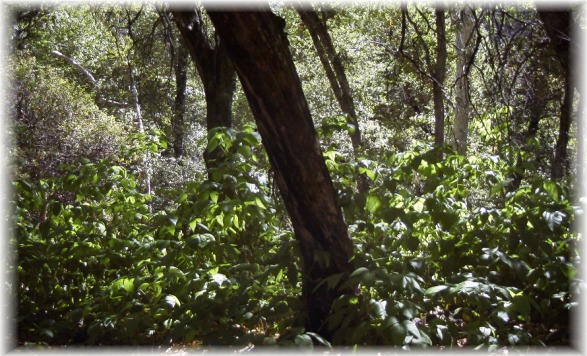
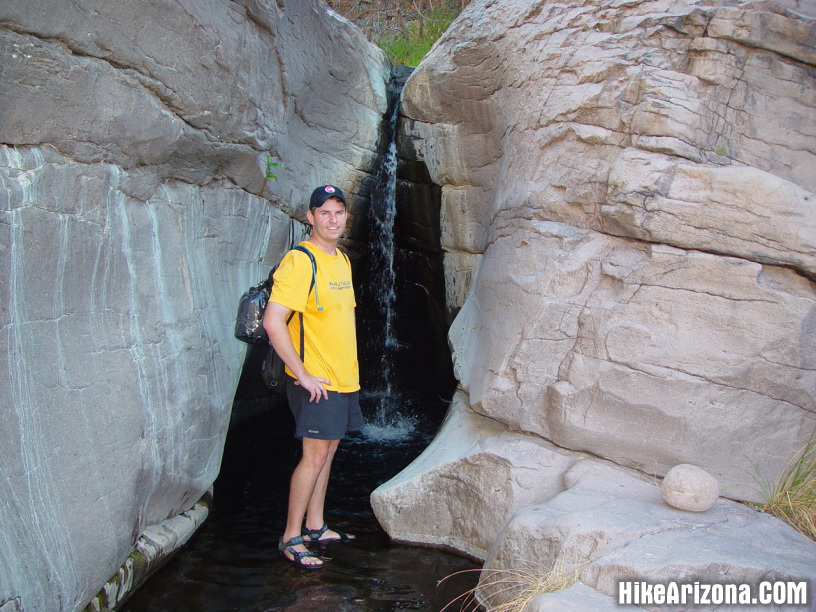
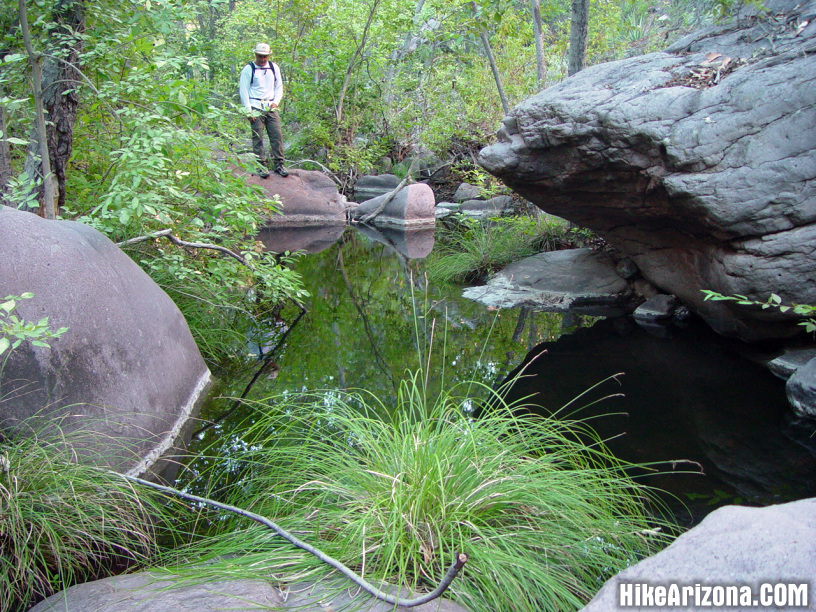
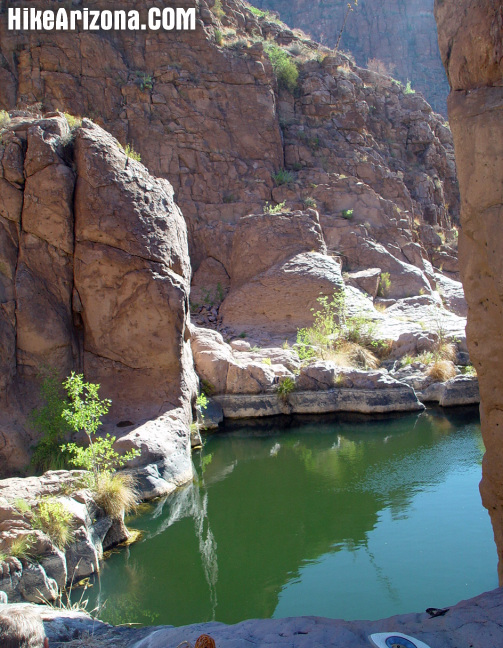
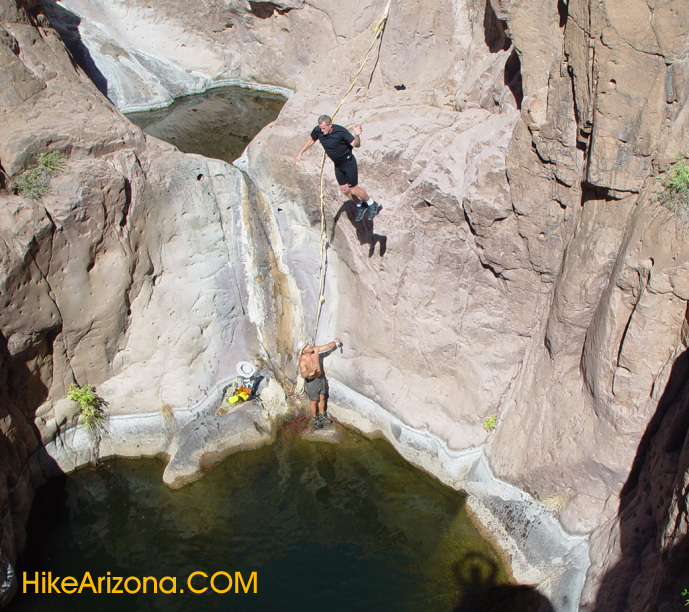
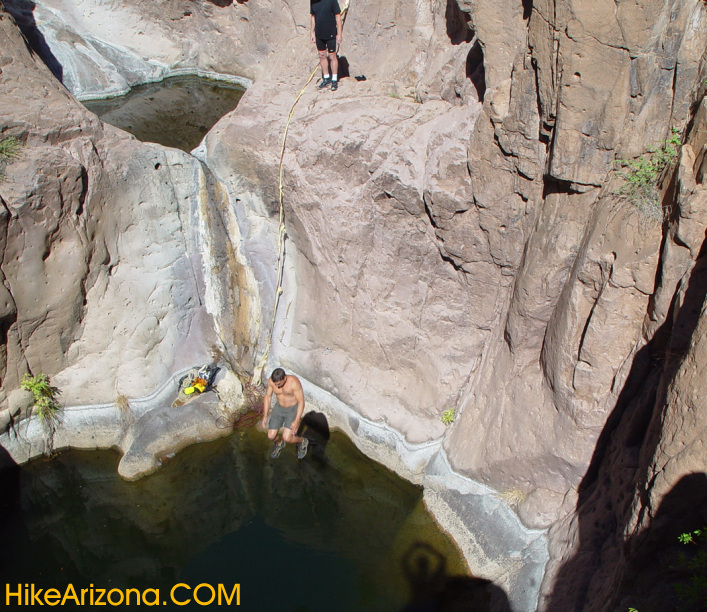
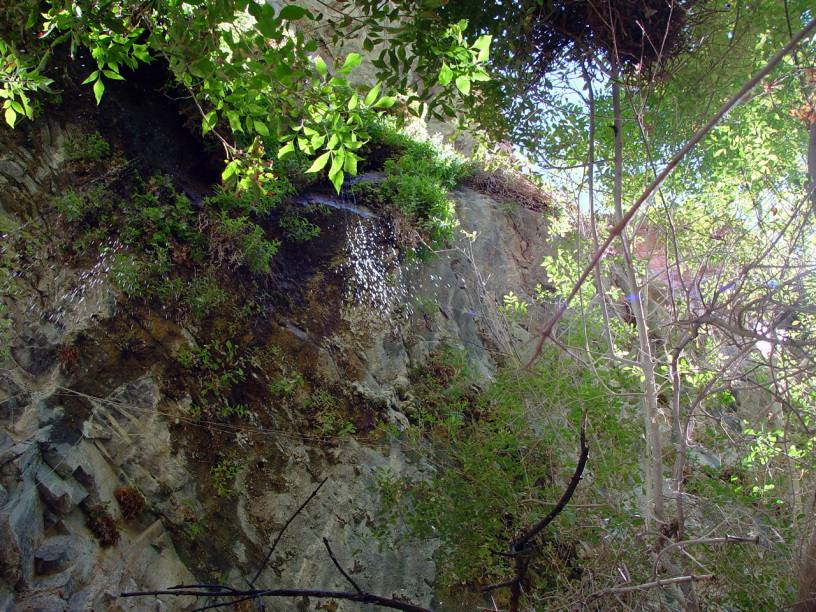
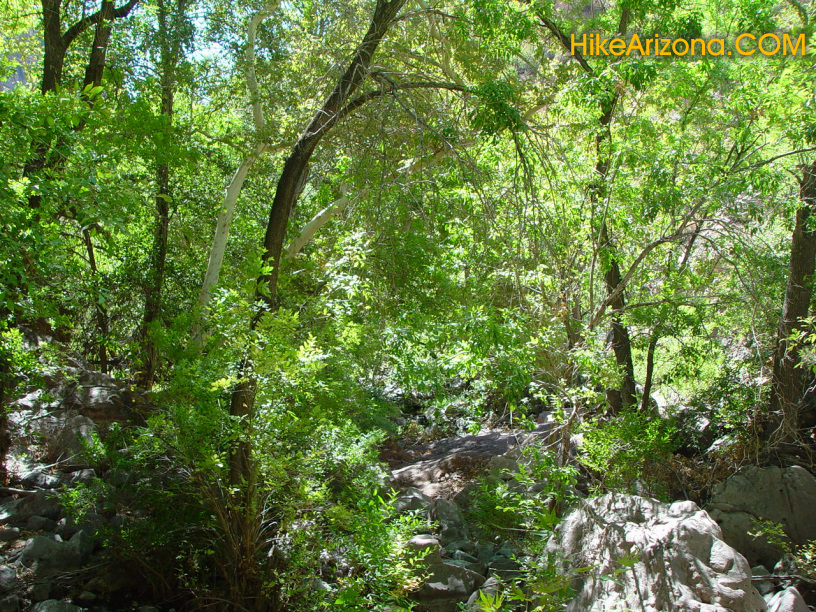
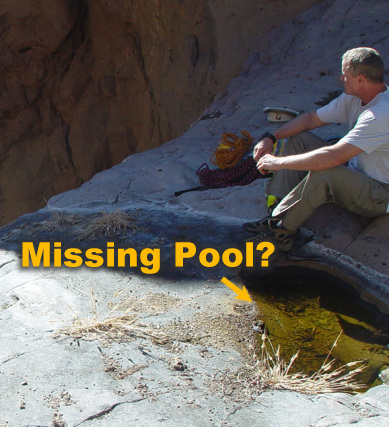
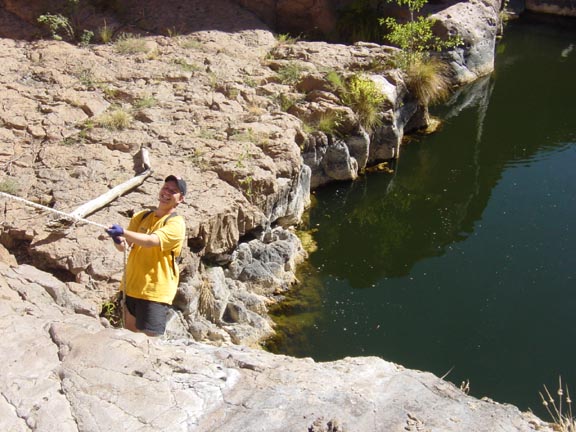
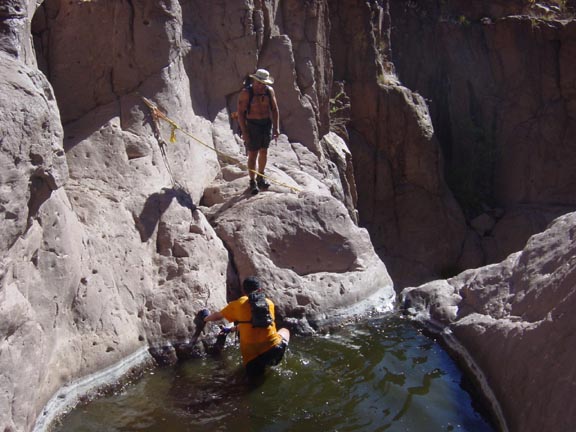
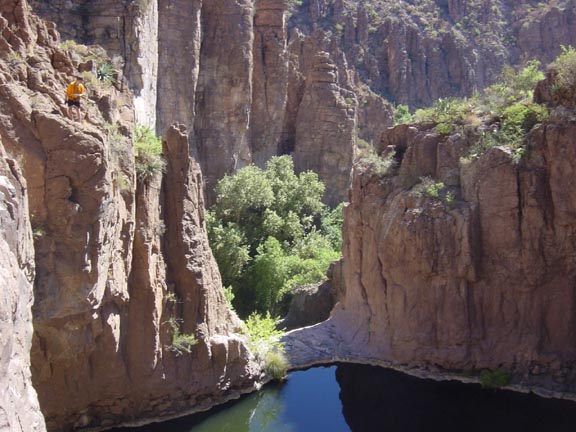
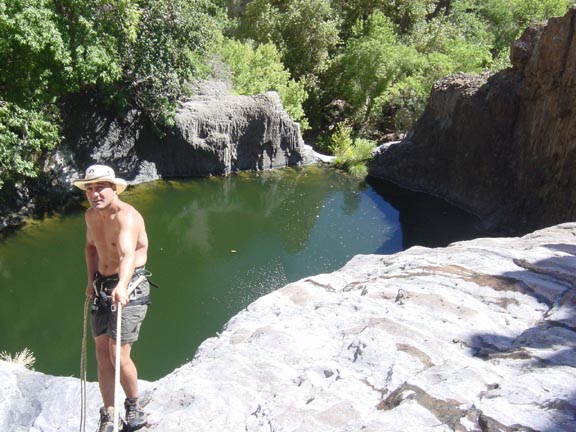
0.7 miles  Upon reaching Devils Canyon thick tree coverage takes over. Take a right/south and head down the canyon. Be forewarned, I've personally witnessed wall to wall poison ivy in which I couldn't imagine getting through. Of most concern is the section between Hackberry Creek & Oak Creek canyons. However, on this trip, it was nearly non-existent compared to years past. Besides, there's a short use-trail that rises slightly on the west side to bypass most of it. The section between these two tributary canyons also boasts the densest bushwhacking. Going in, we bypassed it somehow on the west side wall but, to our surprise, plowed right through it on the return. Upon reaching Devils Canyon thick tree coverage takes over. Take a right/south and head down the canyon. Be forewarned, I've personally witnessed wall to wall poison ivy in which I couldn't imagine getting through. Of most concern is the section between Hackberry Creek & Oak Creek canyons. However, on this trip, it was nearly non-existent compared to years past. Besides, there's a short use-trail that rises slightly on the west side to bypass most of it. The section between these two tributary canyons also boasts the densest bushwhacking. Going in, we bypassed it somehow on the west side wall but, to our surprise, plowed right through it on the return.0.9 miles Continue on passing Oak Creek Canyon. From here to the pools, it's a "which side of the creek is best" battle. A small waterfall is passed along the way along with some beautiful pools. When the canyon suddenly bends east and then west, it's time to get excited as the "Five Pools" are near. My map isn't exact on the pools as I didn't bring my GPS, maybe next time. 2.0 miles The 1st pool is a beauty. This pool has the largest span of low ledges of all the pools on the left. The drop-off is 12 feet. The jump or rappel is the same height from a ledge on the immediate left. Rappel wise it's less as there's a small ledge. This was my first time rappelling/climbing anything. I can tell you first-hand rappelling is twice as scary as climbing. It's just that first step backward over the edge. After that, it's almost fun. Although climbing isn't as scary, I don't have any upper body strength, which was brutal. For the record, I made it up this 120-foot section on my own. Okay, okay, it's maybe 10 feet and by far the easiest as it has a slight slope. I believe there's plenty of handholds to climb if you're experienced at all. Better yet, read Fritzski's mini-tutor below for the technical info. The water temp on this day was perfect. The game plan on all these pools is to swim across. You could come to the first pool and turn around as I'm sure many do. If you're more into swimming and sunbathing, the first pool is plenty. Much further is probably too much unless you're experienced. Keep in mind the trip home up Hackberry Creek Canyon is in full-sun-exposure even with a crack-of-dawn start. The 2nd pool is maybe ten to fifteen yards from the first pool, and it's tiny. It's more of a creek filter than anything you'd want to swim. Since it's a necessary swim, it's tough to leave out. Therefore "Five Pools" is accurate. It does boast a curved slide into the water, which may be fun if the creek is running. Then again, I prefer dry as it'd be a pain going up the smooth, slippery slope. The 3rd pool is a 15 foot drop from the second. The jump or rappel is 3 feet higher from a ledge on the immediate left. I didn't jump any of the pools going down. I believe Fritzski jumped three and Bruce jumped everything in sight. I made it back up this route too. However, more of Fritzski & Bruce pulled a dead body up the escarpment than me ascending on my own. The 4th pool is the largest and highest drop off all wrapped into one package. Everything about this pool is photogenic. The waterfall drop is 50 feet, and the rappel is about 65 feet from a ledge up to the left. Bruce jumped this one from a scramble a third of the way around the left. He said it had a little smack/sting going in but was deep enough. He also mentioned the water down below is cold and makes you swim up fast! The 5th pool is down a short slope from the third. I bypassed the 4th & 5th pools. The fourth pool was so amazing I more or less ignored the fifth pool on details. Instead, I scrambled the left sloping wall down to the lip of the bottom pool. The left bank does add a new variety. A fern lined slope was a pleasant surprise and previously-undocumented to my knowledge. Amazingly, it can grow in this near-desert canyon, especially on these rock walls. The wall is terraced just enough to catch soil from above. Or possibly decades of leaves and wood-decaying as the spongy soil felt like rotted wood. That combined with tree shade and the kicker being a good seep trickling down. Below the 5th pool is a huge sloping slab that resembles poured concrete. It slopes down to a perfectly sharp edge across the canyon. To get below here scramble a short scree slope on the right. I noticed rocks stacked on the left, but the right is the sure way to go. On the left wall a seep drips from high above. Devils Canyon continues down 4.2 miles to a not so happy ending at the mining town Ray. It's lush jungle for as far as I could see. Drama You may not even want to come down this far and reserve some energy. As I didn't realize that the second little tub was a "pool," I was searching for the fifth. Dingbat "Sherlock Teva Holmes" came home and spent countless hours studying photos, water levels, and theorizing "the Missing Pool." It wasn't good. First, I imagined a dynamite alteration between the first and second pools. Of course, this was somebody's kind deed to lower the water lever 3 feet and expose the slimy ledge for easier rappelling or something. Then came the erosion theory. Only to be followed by one last desperate theory. Puzzled, I went back to admiring my photos of un-blurred jumps when it all made sense. Oh that pool! Note Hackberry Creek Canyon and surrounding canyon walls are rock-jock magnets. Most notable is near the Oak Flat Campground, where bouldering contests take place. It's not unusual to see large groups of people in March. Fritzski Technical Notes: To descend through all the "five pools" of Devil's Canyon is considered "technical canyoneering," thus requiring the appropriate equipment, knowledge, and experience. As Joe mentions above, the pools consist of a classic series of plunge pools (1) of which one is a small tub and another a punchbowl (2). 1st Pool: From the top of the first broad dryfall (Sept.) you overlook a 15' drop into the first pool. There was a knotted hand line bolted on the left side for the fairly easy descent. Despite its dilapidated condition, the descent is slightly less than vertical and with good hand and footholds. Of course, just heaving oneself over the edge and into the pool is also an inviting option after the grueling hike. 2nd Pool: Swimming across the first pool, you come to the top of a ramp or chute leading about 12' down to a small tub only about 10' across. This tub would be the sensible limit for those with no technical experience. 3rd Pool: Again, you find yourself at the top of a dryfall, this time overlooking pool #3 where you will again find a hand line bolted to the left side. Here though, the drop is much more sheer, smooth, and slightly farther than previously encountered. We deemed the condition of the rope unsafe and tied our hand line from an extra coil brought along for just such an occurrence. Before commencing this drop, be confident in your ability to climb back up this sheer pitch using hand-over-hand, with the use of a belay or ascenders as an option if needed. Once again, jumping is an attractive option. 4th Pool: From here things take a turn for the technical. You are now overlooking the sheer sides of an immense punchbowl at least 60' straight down to the water. Although my daredevil partner chose to jump "for the fun of it," I wouldn't recommend it. I instead opted for the rappel of which the lower half is free hanging. The anchor bolts look new and solid but bring your own webbing and ring. Having only a 100' static line (3), I had to rig for a single line rappel with retrieval cord (4). You will need rope at the bottom for one last rappel into pool #5. 5th Pool: Swimming out of the bottom edge of the pool you now overlook the final pool #5 and the forested floor of the canyon as it once again flares out from the sheer rock walls. There is a small tree on the left side that serves well as an anchor for the final rappel, which is down a smooth slope and onto a lower ledge where you can make about a 30' jump or continue the rappel into the water assuming you have long enough rope. The exit at the bottom that Joe discussed above will get you back up to the top of pool #4, where you can retrieve your webbing and any other gear you choose to leave there. From there, it is merely a matter of climbing back out via the hand lines (in conjunction with pre-positioned top-roped belays if needed). NOTES: (terms taken from "Canyoneering-Beginning to Advanced" by C. Van Tilburg) (1) Plunge pool - a collection of water at the bottom of a waterfall (2) Punchbowl - large plunge pool (3) Static line - lightweight, low stretch rope designed for rappelling (4) Retrieval Cord - better buy the book :) Fritzski's Factoid: Joe mentions the Yosemite Decimal System for rating technical free climbing from 5.0 up to 5.14 (which is like climbing a piece of sheetrock). But where does the "5" come from, and what does it mean? The Yosemite system lies within a much broader system of terrain classification ratings developed by the Sierra Club. These classes are as follows:
So now when someone says the top of the Flatiron or Brown's Peak requires some class 4 climbing, you'll know what to expect! Flying Bruce - 5.4MB Mpeg Check out the Official Route and Triplogs. Leave No Trace and +Add a Triplog after your canyon trip to support this local community. | ||||||||||||||||||||||||||||||||||||||||||||||||||||||||||||||||||||||||||||||||||||||||||||||||||||||||||||||||||||||||||||||||||||||||||||||||||||||||||||||||||||||||||||||||||||||||||||||||||||||||||||