Mobile Version

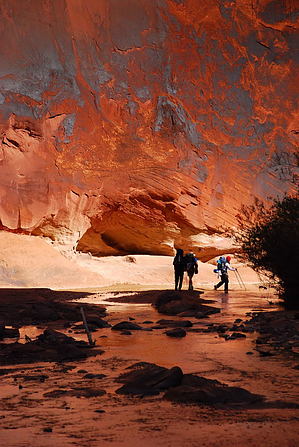
Paria (muddy water) canyon trail on the Arizona Utah border is great prep for the Grand Canyon. You can park in Arizona in Marble Canyon and take a shuttle to Utah for $90 dollars unless you have a group and take two cars. We started at White house entrance wide open canyon which closes quickly to narrow passages very beautiful. From 12 miles in you start running into natural springs which you can drink from. I don't recommend the river water though. You will have springs every so often until 25 miles in, the last spring is 13 miles from the end of the trail so if you are low on water be sure to load up because the last 13 miles of the canyon opens up again and it becomes very hot and there is very little shade. You will do a lot of walking in the river so if you can keep dry as long as you can good luck. Even though the canyon becomes narrow there are a lot of great camping spots. Be sure to camp high in case of flash floods.
On your way to Buckeye or the White house trail head you will pass many natural wonders and great day hike areas. Betty (our shuttle driver) pointed many out which we would have missed other whys. In Marble Canyon there are two nice restaurants to visit once you have completed your hike, not hard to find since it's a small and very friendly community.
Besides the great hikes in this area there is a lot of history and the poeple here are more than glad to tell you about it so don't be shy to ask. Many movies were filmed here; westerns, Evolution, and a lot of others you will have to find out when you talk to the locals.
I got off the hike a bit but there is so much in this area to see. The hike was the Climax of what we saw, heard and experienced.
- May 26 2003 hill180 BLM Division Reports Paria Canyon offers a challenging and enjoyable 38- mile hike for a well-prepared hiker. For ill-prepared hikers, it can become an exercise in survival. Four to five days are recommended to hike from White House Trailhead to Lees Ferry. Please be aware of the Visitor Use Regulations for the area.(Further Down)
Hiking conditions change in the canyon with the seasons. During the popular spring season, plan on hiking in water ankle-to-knee deep. During May and June, the Paria River can be dry for the first seven miles, with the remainder below the Buckskin Gulch confluence flowing year round. This hike can be extremely strenuous and hazardous during months prone to flash flooding. For several days after a flood expect quicksand and mud to make hiking more difficult.
Generally, the route through Paria Canyon is the river bed itself; however, at Mile 28, large boulders clog the river, obstructing this way. Most hikers leave the river at this point and follow a route on the right (south) side of the stream where some scrambling through boulders is required. Choosing to follow the river through this section may not be possible during periods of higher water, and requires negotiating a route through many pools and over large boulders. Hiking in the lower canyon consists of traversing long silt terraces or benches with fewer stream crossings. The long-term or 14-day parking lot at Lees Ferry is reached by staying in the riverbed past the registration box at Mile 38.
The visitor rules apply to the Paria Canyon, Buckskin Gulch, and Wire
Pass portions of the Paria Canyon-Vermilion Cliffs Wilderness, AZ-UT. The
objectives of the rules are to prevent further damage to wilderness resources
and to improve visitors' opportunities to enjoy the area. The rules represent
the minimum level of visitor management needed to accomplish those objectives.
Fees
a. BLM is operating a year-round fee/permit and reservation system.
b. Use fees are collected for all visitors to Paria Canyon, Buckskin
Gulch, and Wire Pass.
c. The fee schedule is: $5.00/person/day.
d. Dogs are allowed in the canyons with the following requirements:
1) Owners pay a daily use fee: $5.00/day for each dog (fees
are not required for guide dogs for the blind.)
2) Owners be informed of rules and restrictions
3) Owners agree to keep dogs under control at all times (to prevent
harassment of wildlife and visitors)
4)Owners dispose of dog waste with the same method used for human waste.
5) All dogs must be on a leash in the Glen Canyon National Recreation
Area portion of lower Paria Canyon.
e. Day-use visitors to these areas
deposit fees at self serve fee stations located at White House, Buckskin
Gulch, and Wire Pass Trail heads. No reservations for day-use are needed.
Each trip leader is required to fill-out a fee envelope and obtain fee
receipt.
f. Overnight visitors must make
a reservation and pay fees at that time, either online or via FAX or mail,
with BLM's fee project partner, Arizona Strip Interpretive Association
(ASIA). A permit is then issued via mail, or you may choose to pick it
up at one of two BLM offices.
g. No fees are charged for children
12 years and under for day-use in Paria Canyon, Buckskin Gulch, and Wire
Pass.
h. Hikers must register at the trail heads when entering or leaving
the area.
i. To keep fees as low as possible, refunds, date changes, and group
size changes will not be made. Processing these types of actions substantially
increases the cost of administration, which requires charging higher fees
to recover costs. Be sure of trip plans before making application and paying
fees.
j. Golden Eagle/Golden Age/Golden Access passes do not apply to use
fees, but are only for entrance fees to areas such as national parks or
some national conservation areas or campground fees.
k. American Indian Access Rights - If it is determined that the canyons
of Paria are sacred or traditional areas to local Native American populations,
then Native Americans are exempted from paying fees.
Reservations
a. Reservations are required for overnight
use in these areas. Permits (Link is further down the page, above the weather chart) are required before entry.
b. All reservations are issued on a first-come, first-served basis.
c. Each trip leader is issued a permit.
d. Overnight use in Paria Canyon, Buckskin Gulch, and Wire Pass is limited
to a combined trail head entry total of no more than 20 persons per day.
Visitor Behavior
a. Group size for all use in the canyons is limited to ten persons per
group. All groups larger than ten must split up and begin hiking on different
days. These groups are not permitted to rejoin during the trip. Minimum
distance is two miles apart.
b. Visitors staying one or more nights in the canyons must camp only
in existing campsites or, if necessary and safe, on shoreline terraces.
c. Wrather Canyon is closed to camping.
d. All camp, latrine, and pack stock restraint areas must be at least
200 feet from springs.
e. Cutting of trees, limbs, or other plants to make camp "improvements"
is prohibited.
f. Private recreational use of horses, burros, llamas, and goats is
allowed in Paria Canyon. Horses must stay on the shoreline terraces.
g. Campfires and burning of trash or toilet paper are not allowed in
the canyons.
h. Disturbing or defacing prehistoric or historic ruins, sites, artifacts
or rock art panels is prohibited by law.
i. All trash associated with an individual or group trip, including
used toilet paper, must be packed out by that individual or group.
j. The wilderness is closed to motor vehicles, motorized equipment,
and other forms of mechanical transport, including bicycles and hang gliders.
k. Hunters (during hunting season, in possession of a valid state license
and permit/tag for the areas), livestock grazing permittees, and employees,
contractors, and volunteers working onsite for a state or federal agency
do not count against the total daily visitor limits, nor are they subject
to fee requirements. However, these individuals are required to comply
with group size limitations. They are subject to any closure or other restriction
implemented to protect sensitive resources.
l. BLM may, based on monitoring, temporarily or permanently close areas
of the canyons in order to protect sensitive resources.
White House Campground
a. For campground use, visitors deposit fees at the self serve fee station
located at the campground. Each group is required to fill-out a fee envelope
and obtain fee receipt. The fee schedule is: $5.00/site/night.
Commercial Guides and Organizations
a. Organized groups, companies, or individuals who use the public lands
for business or financial gain or benefit from salaries, or support other
programs ( ie; professional guides, Sierra Club, schools, college clubs,
Museum or Elder Hostel Sponsored trips, etc.) are considered commercial
users.
b. Commercial users intending to operate within the wilderness must
obtain a Special Recreation Use Permit (43 CFR 8372) prior to operating
on or utilizing public lands.
c. The use of horses in conjunction with an approved Special Recreation
Use Permit is allowed only in Paria Canyon from Bush Head Canyon downstream
to the wilderness boundary.
d. Commercial users may, after receiving authorization through procedures
set forth in 43 CFR 8372, operate in the canyons under one or both of the
following modes:
1) Authorized commercial users will depend on visitors to contract
their services when visitors have either:
a)successfully acquired a non-commercial use permit for areas requiring
reservations/permits or,
b) desired a guide for areas not requiring reservations, such as day-use
in the canyons or the remaining non-fee/non reservation portions of the
wilderness.
All authorized guides will be listed in various forms of BLM hiking
information media, with the information sent to successful permit holders.
Commercial guides may market their availability as guides. As guides are
retained for service under this mode, they will not count against the group
size limit or the total visitor limit for the given day. Parties will be
limited to one guide each under this option.
2) For areas requiring reservations/permits, commercial users compete
with non-commercial visitors for permits on a first-come, first-served
basis. Commercial users reserve no more than one entry day per week under
this option. Fees for reserved dates will be paid at the time of reservation.
For permits reserved under this option, guides will count against both
the group size and the total visitor limit for the given day. BLM would
not limit the number of guides per permit under this option.
FLASH FLOOD WARNING!!
July, August and September are the months with the highest flash flood
danger due to thunderstorms, but they could happen any time of the year.
The Paria Narrows and Buckskin Gulch are the most dangerous areas. If you
find yourself in a possible flash flood situation, get to the highest point
possible. Flood conditions usually subside within 8 to 12 hours. Get a
long-range weather forecast before entering the canyons.
Visitor Use Regulations for Coyote Buttes
The visitor rules apply to the Coyote Buttes portion of the
Paria Canyon-Vermilion Cliffs Wilderness, AZ-UT. The objectives of the
rules are to prevent further damage to wilderness resources and to improve
visitors' opportunities to enjoy the area. The rules represent the minimum
level of visitor management needed to accomplish those objectives.
Fees
a. BLM is operating a year-round fee/permit and reservation system.
b. Use fees are collected for all visitors to Coyote Buttes. Permits (Link is further down the page, above the weather chart) are required before entry.
c. The fee schedule is: $5.00/person (permit required).
d. Day-use visitors must make a reservation and pay fees at that time,
either online or via FAX or mail, with BLM's fee project partner, Arizona
Strip Interpretive Association (ASIA). A permit is then issued via mail,
or you may choose to pick it up at one of two BLM offices.
e. Dogs are allowed in Coyote Buttes with the following requirements:
1) Owners pay a daily use fee: $5.00/day for each dog (fees
are not required for guide dogs for the blind.)
2) Owners be informed of rules and restrictions
3) Owners agree to keep dogs under control at all times (to prevent
harassment of wildlife and visitors)
4)Owners dispose of dog waste with the same method used for human waste.
f. A separate reservation and fee payment must be made for each day requested.
g. Golden Eagle/Golden Age/Golden Access passes do not apply to use
fees, but are only for entrance fees to areas such as national parks or
some national conservation areas or campground fees.
h. To keep fees as low as possible, refunds, date changes, and group
size changes will not be made. Processing these types of actions substantially
increases the cost of administration, which requires charging higher fees
to recover costs. Be sure of trip plans before making application and paying
fees.
i. American Indian Access Rights - If it is determined that Coyote Buttes
is a sacred or traditional areas to local Native American populations,
then Native Americans are exempted from paying fees.
Reservations
a. The Coyote Buttes Special Management Area (SMA) is limited to day-use
only. No overnight camping in the SMA.
b. Reservations are required for day-use in this area.
c. All reservations are issued on a first-come, first-served basis.
d. Each trip leader is issued a permit.
e. Walk-in permits (no reservation) may be available at times. Reservations
for available walk-ins may be made only at the Paria Contact Station up
to seven days prior to the available date.
Visitor Behavior
a. The Coyote Buttes SMA is divided near Top Rock Spring into the Southern
and Northern Coyote Buttes SMAs.
b. Visitor use in the Southern Coyote
Buttes Special Management Area is limited to no more than ten persons per
day.
c. Visitor use in the Northern Coyote
Buttes Special Management Area is limited to no more than ten persons per
day.
d. The maximum group size limit in Coyote Buttes is six persons.
e. Campfires and burning of trash or toilet paper are not allowed in
Coyote Buttes.
f. No private recreational use of horses, burros, llamas, and goats
is allowed.
g. Disturbing or defacing prehistoric or historic ruins, sites, artifacts
or rock art panels is prohibited by law.
h. All trash associated with an individual or group trip, including
used toilet paper, must be packed out by that individual or group.
i. The wilderness is closed to motor vehicles, motorized equipment,
and other forms of mechanical transport, including bicycles and hang gliders.
j. Hunters (during hunting season, in possession of a valid state license
and permit/tag for the areas), livestock grazing permittees, and employees,
contractors, and volunteers working onsite for a state or federal agency
do not count against the total daily visitor limits, nor are they subject
to fee requirements. However, these individuals are required to comply
with group size limitations. They are subject to any closure or other restriction
implemented to protect sensitive resources.
k. BLM may, based on monitoring, temporarily or permanently close areas
of Coyote Buttes in order to protect sensitive resources.
Commercial Guides and Organizations
a. Organized groups, companies, or individuals who use the public lands
for business or financial gain or benefit from salaries, or support other
programs ( ie; professional guides, Sierra Club, schools, college clubs,
Museum or Elder Hostel Sponsored trips, etc.) are considered commercial
users.
b. Commercial users intending to operate within the wilderness must
obtain a Special Recreation Use Permit (43 CFR 8372) prior to operating
on or utilizing public lands.
c. No commercial use of horses, burros, llamas, and goats is allowed.
d. Commercial users may, after receiving authorization through procedures
set forth in 43 CFR 8372, operate in the canyons under one or both of the
following modes:
1) Authorized commercial users will depend on visitors to contract
their services when visitors have either:
a)successfully acquired a non-commercial use permit for areas requiring
reservations/permits or,
b) desired a guide for areas not requiring reservations, such as day-use
in the canyons or the remaining non-fee/non reservation portions of the
wilderness.
All authorized guides will be listed in various forms of BLM hiking
information media, with the information sent to successful permit holders.
Commercial guides may market their availability as guides. As guides are
retained for service under this mode, they will not count against the group
size limit or the total visitor limit for the given day. Parties will be
limited to one guide each under this option.
2) For areas requiring reservations/permits, commercial users compete
with non-commercial visitors for permits on a first-come, first-served
basis. Commercial users reserve no more than one entry day per week under
this option. Fees for reserved dates will be paid at the time of reservation.
For permits reserved under this option, guides will count against both
the group size and the total visitor limit for the given day. BLM would
not limit the number of guides per permit under this option.