| Wright's silktassel |
| Wright's silktassel | 8 locations | Plant |
|
|||||||||||||||||||||||
Garrya wrightii Torr. 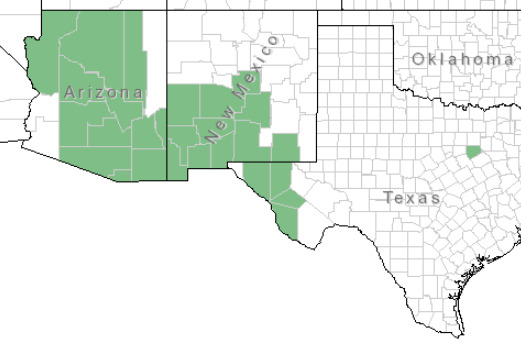 NRCS 2020 Area Distribution The plant is native to northern Mexico and to the southwestern United States in Arizona, New Mexico, and Texas. It is found growing on rocky slopes and in crevices of cliffs, from 5,000–8,000 feet in elevation. Description Garrya wrightii is a shrub slowly growing up to 12–36 feet tall. It has branches that are square in cross-section and thick, tough leaves. The species is dioecious with male and female reproductive parts occurring on separate plants. Both flower types are borne in catkin-like spikes. They are green. The fruit is a rounded purple berry under a centimeter wide containing one or two seeds. The seeds are dispersed by birds that eat the berries. Ecology This shrub grows in chaparral, pinyon-juniper woodlands, and Madrean pine-oak woodlands. It is rarely dominant but it occurs in many types of plant communities. It grows alongside many species of oak such as Emory oak (Quercus emoryi), gray oak (Quercus grisea), and Coahuila scrub oak (Quercus intricata). Other plants in the habitats may include birchleaf mountain-mahogany (Cercocarpus betuloides), true mountain-mahogany (Cercocarpus montanus), skunkbush sumac (Rhus trilobata), desert ceanothus (Ceanothus greggii), pointleaf manzanita (Arctostaphylos pungens), Pringle manzanita (Arctostaphylos pringlei), yellowleaf silktassel (Garrya flavescens), and hollyleaf buckthorn (Rhamnus crocea). It is adapted to wildfire-prone habitat, resprouting after being top-killed in fires. Uses Small amounts of rubber can be made from it. Livestock occasionally eat the plant, goats are especially partial to it. Cattle tend to dislike it because of its bitter taste. Many wild ungulates, such as mule deer, bighorn sheep, and elk browse it. Source Wikipedia |
|||||||||||||||||||||||
| .: DesertNymph :. | |
 |
|
Deadman Falls | |
| .: BubbaJuice :. | |
 |
|
Mount Kimball via Finger Rock | |
| .: BubbaJuice :. | |
 |
|
Mount Kimball via Finger Rock | |
| .: DesertNymph :. | |
 |
|
Granite Mountain Trail #261 | |
| .: joebartels :. | |
 |
|
Yeager - Gaddes - Burnt - Ash - Kendall Loop | |
| .: joebartels :. | |
 |
|
Mazatzal Wilderness 6243 | |
| .: joebartels :. | |
 |
|
Mazatzal Wilderness 6243 | |
|
|
|
|

| Information on this page has been gathered from member submissions. Effort has been made to avoid any infringement of copyright. Additionally, any use is anticipated to be within the "fair use" doctrine. If any copyright has been infringed, please notify the webmaster. The disputed information will be removed and your issue will be resolved. If you are a submitting member, please inform and discuss with HAZ if you think you are submitting any copyright issue. Please help us stay with the law. |
 Route Editor
 Route Scout


